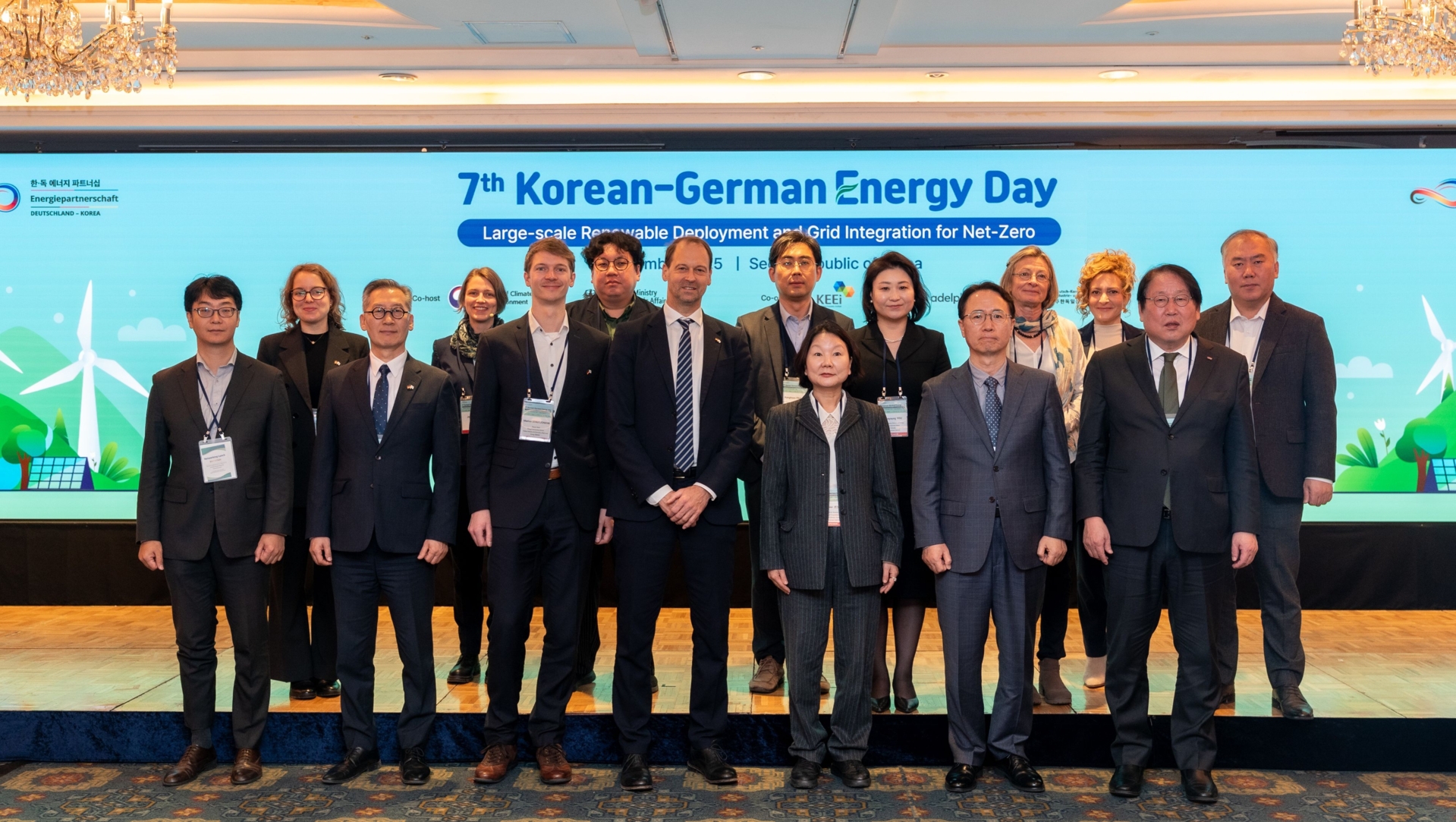
The Korean-German Chamber of Commerce and Industry (KGCCI, President & CEO Marie Antonia von Schönburg) in cooperation with the Korea Energy Economic Institute (KEEI), Korea Institute of Energy Technology Evaluation and Planning (KETEP), German policy consultancy think tank adelphi held the 7th Korean-German Energy Day (KGED) conference on December 2 at Lotte Hotel Seoul.
The KGED is the flagship event of the Korean-German Energy Partnership, co-hosted by German Federal Ministry for Economic Affairs and Energy (BMWE) and Korea’s energy ministry—this year newly reorganized as the Ministry of Climate, Energy and Environment (MCEE). The Energy Partnership was founded in 2019 when a Joint Declaration of Intent was signed by the two countries on extended cooperation in energy transition.
Under the theme “Large-scale Renewable Deployment and Grid Integration for Net-Zero,” this year’s conference attracted more than 150 participants from Korean-German energy sector, government, industry and research. Distinguished speakers included Seungjae Lee, President, Korea Institute of Energy Technology Evaluation and Planning (KETEP), Hyunjae Kim, President, Korea Energy Economics Institute (KEEI), and Hoje Woo, Senior Vice President of KGCCI.
In opening remarks, Hoje Woo, Senior Vice President of KGCCI, emphasized, “Germany and Korea face the same urgent challenge: expanding renewable energy at speed while keeping our grids stable and our economies competitive. Today’s dialogue makes one thing clear—the path forward is partnership. When our two countries align policy ambition with technological excellence and industrial know-how, we accelerate the energy transition together.”
Keynote presentations addressed overarching energy policy directions in both countries: Eunhae Jeong, Director General, International Cooperation Bureau, Korean Ministry of Climate, Energy and Environment (MCEE), and Axel Bree, Deputy Director General for International Energy Politics, Federal-State Coordination and Energy Efficiency, German Federal Ministry for Economic Affairs and Energy (BMWE).
Eunhae Jeong, Director General at MCEE said, “Korea stands at a critical turning point where accelerating renewable energy deployment and modernizing the power grid are essential to achieving the 2035 NDC,” adding, “As today’s discussions highlighted, this transition cannot be achieved without international cooperation. The Korean government will actively contribute to the global journey toward carbon neutrality together with Germany.”
Axel Bree, Deputy Director General at BMWE, emphasized, “The Korean-German Energy Day is the main annual event of our Korean-German Energy Partnership. It is an important sign of the good cooperation and friendship between our countries and enables intensive discussions and mutual learning in energy and climate policy.”
The conference was conducted into two sessions: △Scaling Renewable Energy Deployment in Korea and Germany △Transforming Electricity Grids for a Renewable Future. The first session examined how Korea and Germany can strengthen strategies for renewable expansion amid rising electricity demand and ambitious climate neutrality pledges. Speakers included Kanghoon Park, Team Manager, Policy Management Team, RE Policy Division, Renewable Energy Center at Korea Energy Agency (KEA); Marius Strotjohann, Deputy Head, Energy Partnership Division, BMWE; Taekwon Seo, Head of Stakeholder Management Team/Senior Stakeholder Manager, RWE Korea; Deokhwan Choe, Head of External Relations & Government Affairs, Korea Wind Energy Industry Association (KWEIA); Barbara Breitschopf, Researcher, Fraunhofer Institute for Systems and Innovation Research (Fraunhofer ISI); Kongjang Cho, Chief Research Fellow, Korea Environment Institute (KEI). Presentations highlighted the status quo of renewable energy policy, challenges in community acceptance, and effective models for citizen participation in energy transition investments. A panel discussion followed, engaging the audience in Q&A on how to address regulatory, technical, and societal barriers to accelerating renewable energy development.
The second session focused on the critical grid transformation required to maintain stability and enable large-scale integration of variable energy sources. Speakers included: Concetta Behler, Head of Strategy, Amprion GmbH, Hyunju Lee, Manager, Korea Power Exchange (KPX). Their presentations addressed grid expansion needs, new operational strategies, and technical approaches to managing fluctuating renewable generation.
Further expert inputs were provided on innovative technology solutions: Changsun Kim, Program Director, Korea Institute of Energy Technology Evaluation and Planning (KETEP); Haksu Lee, Manager, Grid Technologies Division, Siemens Energy — “Innovative Solutions for Grid Resilience and Stabilization”; Lena Grimm, Analyst, Korean-German Energy Partnership Team, adelphi consult — presenting findings from the study “Battery Energy Storage Systems in Korea and Germany.” Speakers emphasized the significance of battery storage, digital monitoring, and smart grid technologies in enabling resilient, future-proof electricity systems.
The event closed with a bilateral interview, underscoring Korea and Germany’s continued commitment to joint action on renewables, technology innovation, and strategic energy policy alignment as Korea and Germany work toward shared net-zero goals.
Jihee Jeong, Chair of the Secretariat of Korean-German Energy Partnership in Korea stated, “Since its launch in 2019, the Korean-German Energy Partnership has become an indispensable platform for bilateral cooperation in the energy sector between Korea and Germany. As the Secretariat of the Partnership in Korea, the KGCCI will continue to bridge policy and industry and support both countries in advancing technological innovation and energy security”
Designated as the official secretariat of the Korean-German Energy Partnership in 2021, KGCCI with adelphi together underpins cooperation between the two countries in various areas, facilitating interactions between policymakers and energy experts in close cooperation with stakeholders from both countries. In specific, KGCCI co-organizes and executes Korean-German Energy Partnership Working Group Meetings, energy workshops, expert meetings, delegation trips, and is also the co-organizer of the Korean-German Energy Day.